

Ausbildung in Germany — The Paid Apprenticeship That Could Change Your Life
Germany has one of the most distinctive education systems in the world. Alongside its tuition-free universities, it offers something very few countries can match: a nationally recognised, paid vocational training programme taken just as seriously as a university degree — and in many fields, leading to higher earnings and better job security. It is called an Ausbildung. And it could be your path to Germany.
What Is an Ausbildung?
An Ausbildung (pronounced “ows-beel-doong”) is Germany's dual vocational training system — a paid apprenticeship that combines on-the-job training at a company with classroom learning at a vocational school (Berufsschule). You do both simultaneously, typically spending three to four days per week with your employer and one to two days per week in school.
The programme runs between two and three and a half years, depending on your chosen profession. Once you complete it, you receive a qualification recognised across the entire European Union, issued by the relevant German chamber.
This is not a second-class option. In Germany, vocational training has a long and proud tradition. Roughly half of all young Germans choose the Ausbildung route over university. Many of the country's most successful engineers, business managers, healthcare professionals and tradespeople began their careers as Azubis (apprentices).

The Meister — Germany's Master Qualification
After completing an Ausbildung, you can go further. The Meister (master craftsman or specialist) qualification is the highest level of vocational education in Germany — roughly equivalent to a master's degree in terms of career standing and earning potential. It qualifies you to run your own business, take on apprentices yourself, and reach senior leadership positions in your field.
Earn from day one — no financial means required
Unlike university study, an Ausbildung does not require a blocked account or significant upfront savings. You earn a training salary (Ausbildungsvergütung) from your very first day. According to the Federal Institute for Vocational Education and Training (BIBB), the average training salary across all Ausbildung sectors reached approximately €1,070 per month in 2025, with higher-demand fields paying significantly more. This makes the Ausbildung one of the most financially accessible routes into Germany for international candidates with limited means.
Germany has more Ausbildung places than it can fill
According to the DIHK Apprenticeship Survey 2025, every second company across industry, commerce and services was unable to fill all its apprenticeship positions last year. Shortly before the start of the apprenticeship year, 130,000 vacancies remained unfilled. In 2025–2026, 1 in 3 first-year apprenticeships went unfilled.
German businesses are now actively recruiting internationally to fill these gaps — and the German government has changed its visa rules to make it easier, raising age ceilings and lowering language requirements for international applicants.
What Subjects Does an Ausbildung Cover?
Germany recognises over 325 official Ausbildung professions across virtually every sector of the economy.
Healthcare and social care: Nursing professional (Pflegefachmann/-frau), dental assistant (Zahnmedizinische Fachangestellte), physiotherapy assistant, geriatric care assistant, medical assistant
IT and technology: IT specialist — application development (Fachinformatiker/in Anwendungsentwicklung), IT specialist — system integration, IT system electronics technician
Trades: Electrician (Elektroniker/in), pipefitter/plumber (Anlagenmechaniker/in SHK), mechatronics technician (Mechatroniker/in), HVAC technician, construction mechanic — and many more
Logistics and warehousing: Warehouse logistics specialist (Fachkraft für Lagerlogistik), professional driver (Berufskraftfahrer/in)
Hospitality: Hotel management assistant (Hotelfachmann/-frau), restaurant specialist, cook (Koch/Köchin)
White-collar and office: Industrial business management assistant (Industriekaufmann/-frau), office management clerk, bank clerk, social insurance clerk
Most popular among international candidates
Based on visa approvals and application volume from Nigeria, India, Ghana and Kenya:
- →Nursing and healthcare — high demand, well-paid, clear recognition pathway
- →Hotel and hospitality — lower language barrier at entry, high hiring volume
- →IT specialist — strong earning potential, global skills transferability
- →Electrician and HVAC — acute shortage, strong salary progression
- →Mechatronics technician — high demand in automotive and industrial sectors
- →Logistics — including bus and truck drivers, warehouse specialists
- →Industrial business management — white-collar entry point into German corporate environments
- →Dental assistant — Germany's #1 shortage profession, actively recruiting internationally
How Much Do I Earn During an Ausbildung?
You are paid from day one. Figures below are typical gross monthly training salaries for 2026. Source: BIBB, Ausbildung.de
| Profession | Monthly training salary | Demand |
|---|---|---|
| Air traffic controller (Fluglotse) | €1,200–5,900 | Low volume, very selective |
| Nursing professional (Pflegefachmann/-frau) | €1,100–1,350 | Very high |
| Dental assistant (Zahnmedizinische Fachangestellte) | €750–950 | Very high |
| Electrician (Elektroniker/in) | €1,000–1,150 | High |
| Construction specialist (Spezialtiefbauer/in) | €950–1,500 | High |
| Kindergarten teacher (Erzieher/in) | €1,300–1,500 | High |
| Hairdresser (Friseur/in) | €620–800 | Medium |
| Industrial business mgmt (Industriekaufmann/-frau) | €950–1,100 | Medium |
| IT specialist (Fachinformatiker/in) | €1,000–1,250 | Very high |
| Mechatronics technician (Mechatroniker/in) | €1,050–1,200 | High |
| Bank clerk (Bankkaufmann/-frau) | €1,100–1,200 | Medium |
Salaries increase by year of training. Union contracts and large employers sit at the upper end; small businesses may pay closer to the minimum.
Ask us which Ausbildung pays best for your backgroundHow Much Do I Earn After an Ausbildung?
Completing an Ausbildung opens doors quickly. Many graduates receive a full-time job offer from their training company — and even those who do not have 18 months to find alternative employment without leaving Germany. Starting salaries are competitive with — and in several cases exceed — what university graduates earn in the same sectors.

| Profession | Starting salary | Growth potential |
|---|---|---|
| Air traffic controller | €4,000+ | One of Germany's highest-paid professions |
| Nursing professional | €3,000–3,200+ | Strong; shift bonuses common |
| Dental assistant | €2,200–2,800 | Rises with additional qualifications |
| Electrician | €3,000–3,500 | High; industrial/automotive pays more |
| Construction specialist | €3,000–3,500 | Overtime and allowances common |
| Kindergarten teacher | €2,800–3,200 | State-sector pay scale increases |
| Hairdresser | €1,800–2,200 | Higher with own salon or management role |
| Industrial business mgmt | €2,800–3,200 | Strong corporate pathway |
| IT specialist | €3,000–3,800 | Fast growth; €4,000+ with specialisation |
| Mechatronics technician | €3,000–3,500 | Higher with shift work; automotive |
| Bank clerk | €2,800–3,200 | Strong upside in advisory/sales roles |
Sources: BIBB, Entgeltatlas — Bundesagentur für Arbeit
Where Germany Needs You Most
Germany officially tracks its most acute workforce shortages through the annual Fachkräfteengpassanalyse published by the Bundesagentur für Arbeit. In 2024, 163 out of approximately 1,200 assessed professions were classified as shortage occupations.
Healthcare
Dental assistant (Zahnmedizinische Fachangestellte/r) — Germany's #1 shortage profession
According to the Fachkräfteengpassanalyse 2024, dental assistants ranked first among all shortage professions — no other profession had as acute a skills gap, with a bottleneck score of 2.8 out of 3.0. Dental practices wait an average of over four months to fill a single open position. Source: KZV BW
Nursing professional (Pflegefachmann/-frau)
Germany's nursing shortage is structural and worsening. Demand is expected to rise 33% by 2049 — from 1.62 million in 2019 to 2.15 million — potentially creating a shortage of between 280,000 and 690,000 nurses.
Physiotherapy, medical assistants and geriatric care
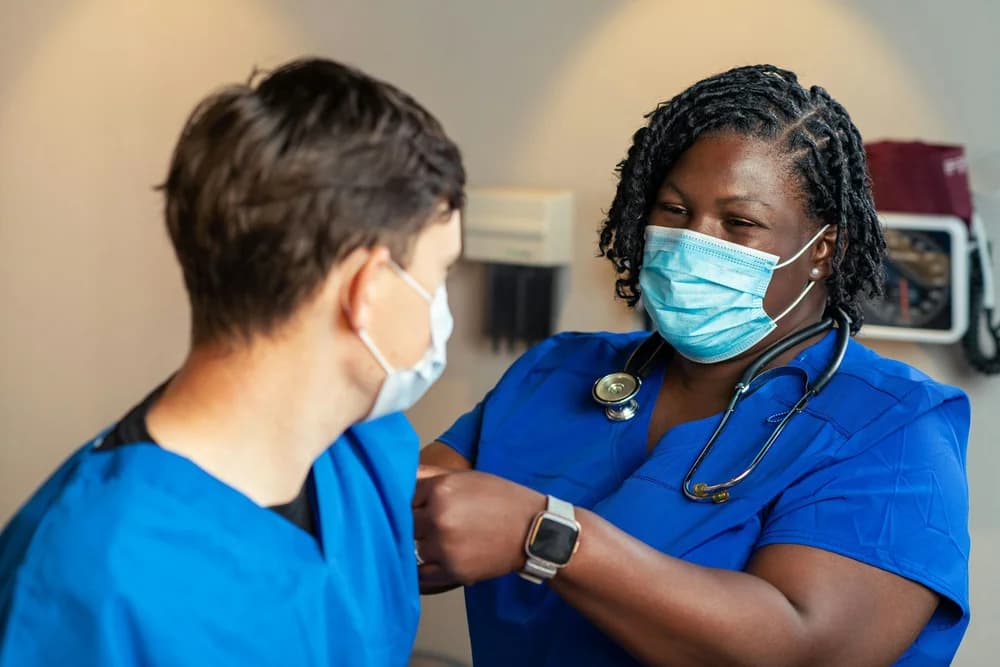
Physiotherapists, medical assistants (Medizinische Fachangestellte) and geriatric care assistants are also consistently listed among Germany's shortage professions — hands-on, people-centred roles with strong job security.
Construction and Trades
Germany's construction and infrastructure boom — driven by housing demand, the energy transition and public investment — has created acute shortages across the trades. Road and asphalt workers saw their shortage jump 38% compared to 2024.
- →
Electrician (Elektroniker/in) — one of Germany's most consistently short-staffed trades; essential for the energy transition
- →
Pipefitter/plumber (Anlagenmechaniker/in SHK) — heating, sanitation and plumbing specialists needed across residential and commercial construction
- →
HVAC technician (Mechatroniker/in Kältetechnik) — rapidly growing with the push for energy-efficient buildings
- →
Painter and varnisher — high hiring volume, relatively accessible entry requirements

Hospitality — Hotels and Restaurants
Germany's hospitality sector consistently struggles to find enough trained staff. The Ausbildung as a hotel management assistant (Hotelfachmann/-frau) or restaurant specialist is one of the most accessible routes for international candidates:
- Language requirements at entry are typically lower — B1 German is generally sufficient
- Training is largely practical and learned on the job
- Germany's hospitality sector is distributed across the entire country, meaning more opportunities and more affordable living during training
- Many hotels and restaurant groups actively recruit internationally and provide support with accommodation and onboarding
How Do I Secure an Ausbildung from Abroad?
The process has four clear steps. Each one matters — skipping or rushing any of them is the most common reason international candidates do not succeed.
Step 1: Learn German
This is the single most important step — and the one to start immediately, regardless of which profession you are considering. Most Ausbildung programmes require German at B1 level as a minimum, and many employers prefer B2. The classroom component is taught in German, and day-to-day work in most sectors requires functional German. The good news: German can be learned to B1 in 6–9 months of consistent study.
Step 2: Choose your industry
Not all Ausbildungen are equally accessible to international candidates. The easiest entry points in terms of language, visa pathway and employer openness are healthcare, hospitality, IT and trades. White-collar programmes (Industriekaufmann, bank clerk) are possible but typically require stronger German and a more competitive application.
Step 3: Find an employer and apply
Unlike university, an Ausbildung requires you to secure a training contract (Ausbildungsvertrag) with a specific company before applying for your visa. You apply directly to employers — not to a central admissions office.
Best platform: Ausbildung.de — Germany's largest apprenticeship portal with thousands of live vacancies. Also: Bundesagentur für Arbeit Jobbörse.
Step 4: Go through the embassy process
Once you have a signed training contract, you apply for your visa. There are two relevant visa types:
- Ausbildung Visa (§16a AufenthG) — for candidates who already have a confirmed training contract
- Ausbildung Seeker Visa (§17 AufenthG) — for candidates under 35 who want to come to Germany first and find a training place on the ground
Can I Bring My Family During an Ausbildung?
Yes — under certain conditions. If you can demonstrate sufficient income to financially provide for your family and have appropriate housing, family reunification during an Ausbildung is typically possible. Some MiGreat clients have successfully brought their families even during their training period.
What Happens After My Ausbildung?
Most common outcome: full-time employment with your training company
The majority of Azubis receive a job offer from the company where they trained. In shortage sectors — healthcare, IT, trades — this is almost guaranteed. You know the team, they know you, and hiring someone they have already trained for three years is simply good business.
18 months to find your next role
After completing your Ausbildung, you are entitled to an 18-month job seeker permit — giving you time to find qualified employment in Germany without leaving the country.
The Meister pathway
With a few years of work experience, you can pursue the Meister qualification — the highest level of German vocational education. It qualifies you to run your own business, take on apprentices, and reach the top of your profession. In trades and healthcare, a Meister earns as much as — and often more than — a university graduate.
Further study
Many Ausbildung graduates go on to university. Germany has created specific pathways for vocational graduates to enter higher education — including technical universities (Fachhochschulen) — based on their completed Ausbildung rather than a traditional school-leaving certificate.
An Ausbildung is not just a qualification. It is a career, a visa pathway, a salary from day one, and — for the right candidate — one of the most reliable routes to a stable, well-paid life in Germany.